如何用tikz在\documentclass{article}中绘制函数图像
源文件:test.tex
\documentclass{article}
\usepackage{pgfplots}
\pgfplotsset{compat=1.16}
\usepackage{graphicx}
%\usepackage{subfigure}
\usepackage{float}
\usepackage{caption}
\usepackage{subcaption}
\usepackage{indentfirst}
\usepackage{amsfonts,amscd,amssymb,amsthm} %美国数学会套装
\newtheorem{lemma}{lemma}[section]
\setlength{\parindent}{2em}
\author{Dean}
\title{\huge An Report on a Limit ${\lim\limits_{x\to \frac{\pi}{2}+k\pi}\frac{x}{\tan x}}$\\(Example)}
\date{March 18,2022}
%区分间隔
\begin{document}
\maketitle
\begin{abstract}
\Large As a result of the barriers of discussing $y=\tan x$, it is a huge problem to prove something we need. The article states the process systematically.
\end{abstract}
%第一部分
\section{$Lemma$}
\Large \begin{lemma}
Firstly, proving a significant inequation:$|x|\ge|\sin x|$.\\
\begin{tikzpicture}
    \draw (0,0) circle (1);
\end{tikzpicture}
\begin{tikzpicture}
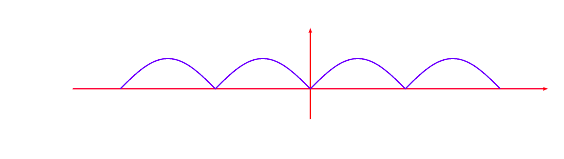
\begin{axis}
    \addplot {$\mid \sin x \mid $}
\end{axis}
\end{tikzpicture}\\
\begin{proof}
$\angle AOB=x,x\in (0,\frac{\pi}{2})$\\
$S_{fanshaped AOB}>S_{\Delta AOB}$\\
$\frac{1}{2}xR^2>\frac{1}{2}R^2\sin x$\\
When $0<x<\frac{\pi}{2}, |x|>|\sin x|$\\
When $x\ge\frac{\pi}{2}, |x|\ge \frac{\pi}{2}, |\sin x|\le 1$\\
So $|x|>|sinx|$\\
Above all, when $x>0, |x|>|\sin x|$\\
When $x<0$,\\
$|-x|>|\sin (-x)|$\\
$|x|>|\sin x|$\\
When $x=0$,\\
$|x|=|\sin x|$\\
Above all, when $x\in R, |x|\ge |\sin x|$.
\end{proof}
\end{lemma}
\Large \begin{lemma}
As we all know, The limit that a limited function multiplies a function whose limit equals 0 is 0, too. Proving the other deduction below:\\
%首行缩进

f(x), g(x) are defined when $x\in D$, where $D\subset D_g$, $D_g$ is the natural domain; $\exists M>0$, $|g(x)|\le M$; ${\lim\limits_{x\to x_0}f(x)=0}$  $x_0\in D$ is not on the special boundary poin$t^{(1)}$, So${\lim\limits_{x\to x_0}f(x)g(x)=0}$.
%画图
$\exists \delta>0,0<|x-x_0|<\delta$\\
$\varepsilon>0,|f(x)-A|<\varepsilon$\\
\\
$\exists M>0$\\
$|g(x)\le M|$\\
\\
$|f(x)g(x)|<M\varepsilon$, let $\varepsilon =\frac{\varepsilon _0}{M}$\\
$|f(x)g(x)|<\varepsilon _0$
To $0<|x-x_0|<\delta $\\
$x_0 -\delta <x<x_0 +\delta $\\
\Large If the section is included in D, too. It satisfies;If the section is not included in D completely, then there exists a neighbourhood section $U^0 (x_0)\in D$ which is set up as well.
Above all, lemma set up.
\end{proof}
\end{lemma}
%第二部分
\section{$Theorem$}
\Large Until now, we have prepared all the lemmas we need. We prove the limit mentioned on the title.
\begin{proof}
${\lim\limits_{x\to \frac{\pi}{2}+k\pi}\frac{x}{\tan x}}={\lim\limits_{x\to \frac{\pi}{2}+k\pi}\frac{1}{\tan x}}{\lim\limits_{x\to \frac{\pi}{2}+k\pi}x}$\\
After that, we solve the limit of $y=\frac{1}{\tan x}$.\\
${\lim\limits_{x\to \frac{1}{\tan x}+k\pi}\frac{1}{\tan x}}={\lim\limits_{x\to \frac{\pi}{2}+k\pi}\frac{\cos x}{\sin x}}={\lim\limits_{x\to \frac{\pi}{2}+k\pi}\frac{1}{\sin x}}{\lim\limits_{x\to \frac{\pi}{2}+k\pi}\cos x}$\\
We limit $x\in (\frac{\pi}{2}+k\pi -1,\frac{\pi}{2}+k\pi +1)$. According to the second lemma, $y=\frac{1}{\sin x}$ obviously is a limited function. At the same time, we know that ${\lim\limits_{x\to \frac{\pi}{2}+k\pi}\cos x=0}$\\
Then ${\lim\limits_{x\to \frac{\pi}{2}+k\pi}\frac{1}{\tan x}=0}$\\
Thus we can acquire the answer:\\
${\lim\limits_{x\to \frac{\pi}{2}+k\pi}\frac{x}{\tan x}}={\lim\limits_{x\to \frac{\pi}{2}+k\pi}\frac{1}{\tan x}}{\lim\limits_{x\to \frac{\pi}{2}+k\pi}x}=0$\\
That is the last Step.
\end{proof}
\end{document}
查看更多